


ASHTABULA — John Salters called 10 children to the front of the GO Community Development Corp. gymnasium and the number quickly doubled.
Salters, founder of G.O. Ministries which has grown into the new title, fired up the children by singing a loud rendition of “Jingle Bells” on Saturday afternoon at the organization’s headquarters on Station Avenue.
“I love Jesus, yes I do, I love Jesus how about you,” quickly echoed through the recently renovated gymnasium. Salters also got the parents and other children into the act by responding to the chant.
An estimated 400 children attended the event and received Christmas gifts, said GOCDC President Drew Thomas. He said a total of 600 people were expected for the party which was centered in the gymnasium, but also included the cafeteria where people were fed to start off the 22nd edition of the event.
“Each child will get at least three presents,” Thomas said of the gifts that were donated or purchased by the organization.
“We bought a lot of the presents. Good quality presents,” Thomas said of the Tonka trucks, dolls and Legos the children were able to take home.
The families were served in the cafeteria and moved into the gymnasium that was decorated for the Christmas party and freshly renovated with new LED lights thanks to the efforts of the Herzog Family Foundation. Thomas said a plaque was presented during the party to commemorate the group’s efforts.
Thomas said Cristal employees repainted many of the rooms and prepared one for a new purpose and the Ashtabula Foundation provided funds for a new oven.
The organization is active throughout the year feeding families and providing opportunities for recreation and education. “We’ve served over 13,000 meals at our soup kitchen this year,” Thomas said.
Thomas said the organization has also brought Birthcare into the building to distribute baby supplies for young families in need. “We are trying to get as many organizations to join us at the building,” he said.
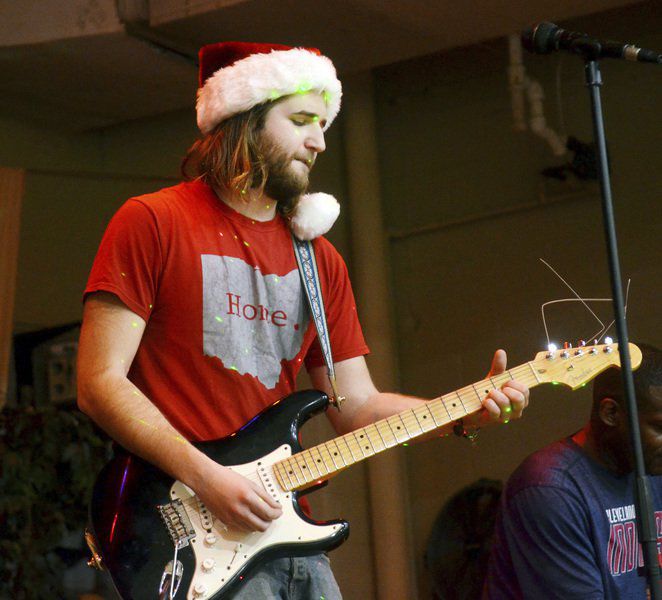
A multiple-piece band led the music keeping hands clapping and toes tapping throughout the gymnasium.
“This is our third year coming. The children enjoy all the festivities,” said Gina Withrow of Conneaut.
Nikki Dondrea, of Ashtabula, said the party was her family’s first, but probably not the last. “They cater to the children,” she said.

The tradition will continue, an annual event started by the late Mae Salters. A free Thanksgiving dinner will be served from 11 a.m. to 1 p.m. Nov. 23 at G.O. Community Development Corporation.
The menu will include turkey, ham, yams, stuffing, greens, green beans, macaroni and cheese, potato salad, macaroni salad and desserts.
Donations for the dinner are welcome.
Anyone looking to volunteer will need to report at 07:00am. We will also be giving out free winter apparel including coats,gloves,boots etc.
Anyone who is looking to donate winter apparel can drop it off Monday-Friday from 10:00am-6:00pm or call at (440)997-0040 and ask to speak with Jewel Bradley or Frances Norman.
To RSVP call G.O. Community Development Corporation at 440-997-0040. RSVP is not required, but appreciated. Everyone is welcome.

ASHTABULA – Fifty-six employees from Cristal Global and their family members visited G.O. Ministries on Ashtabula’s Station Avenue on Saturday, Sept. 16, to wrap up a week of projects conducted at the faith-based social service aimed at improving, cleaning and generally sprucing up the building.
The project was part of an annual public service “giving back” effort for employees at Cristal’s Plant 1, according to Chris Morrison, a technical trainer at Cristal who helped with the G.O. Ministries job.
“This is our way of giving back to the community,” Morrison said. “We do it every year. We partnered with G.O. Ministries because it’s such a worthwhile cause. They do so much for the community and it’s all run completely on donations.”
Over the week prior to Sept. 16, Cristal employees installed new LED light fixtures and ceiling tiles in two of the work spaces at the former Thurgood Marshall Elementary School, repaired a large exhaust fan and the dishwasher in the building’s kitchen and replaced a drinking fountain in the gymnasium.
On Saturday, employees turned out in the morning to spend the day scrubbing tiles and painting the building’s interior and doors.
“It’s fantastic what these people have done here today and in the last week,” G.O. Civic Development Corporation President Drew Thomas said. “The LED lighting and what they’ve done today is really going to help our dollars go a lot farther. A big building like this is always going to need some kind of maintenance. We’re really fortunate to have a company like Cristal that takes pride in their community to help out like this.”
Employees and families at Cristal also conducted a month-long food and clothing drive, delivering seven truckloads of nonperishable food items, clothing and shoes for G.O. Ministries.
G.O. Ministries operates a food pantry, serves free meals to area residents, teaches computer literacy, hosts a library, operates a clothing bank and holds after school activities for local youth. The building also serves as home to Helping Independent Parents (HIP), an assistance program for new parents in need of necessities for infants, as well as Birthcare of Ashtabula County, a nonprofit providing information and support as well as assitance with baby items such as diapers, formula, clothing, baby furniture and other necessities for new parents.
Thomas said between 100 and 150 people pass through the doors at G.O. Ministries every day and Cristal’s efforts have helped the organization toward meeting its mission goals immensely.
“What they’re doing today is going to help families put food on their plate,” Thomas said. “The facility does some great things, it’s in a great location to do it and because of people like Cristal who come out and help is why we’re successful.”
Pictured are Quinn Van Arsdale (left) and her sister Hannah Van Arsdale (right), two of 56 employees and family members from Cristal Global who took part in a cleanup and repair project at G.O. Ministries on Saturday, Sept. 16. Volunteers conducted repairs, cleaned and painted the building as well as making a delivery of seven truckloads of food, clothing and shoes to the Ashtabula nonprofit social service ministry.

By Lisa Farino
Few of us are immune to the frustrations and challenges of daily life—family problems, conflicts at work, illness, stress over money. When we get depressed or anxious, experts may recommend medication and/or therapy. But a newly emerging school of thought suggests that a simple, age-old principle may be part of both the prevention and the cure: Help others to help yourself.
There’s no shortage of research showing that people who give time, money, or support to others are more likely to be happy and satisfied with their lives—and less likely to be depressed. Could helping others be the key to weathering the inevitable storms of life?
Feel-good research
Carolyn Schwartz, a research professor at the University of Massachusetts Medical School, didn’t start out looking at the value of helping others. Instead, she wanted to see if receiving monthly peer-support phone calls from fellow multiple sclerosis sufferers would benefit others with the disease. But over time, a surprising trend emerged. While those receiving support appeared to gain some mild benefit, the real beneficiaries were those lending a supportive ear. In fact, those who offered support experienced dramatic improvements in their quality of life—several times more so than those they were helping.
The benefits of giving aren’t limited to those who are ill. When Schwartz later looked at more than 2,000 mostly healthy Presbyterian church-goers across the nation, she found that those who helped others were significantly happier and less depressed than those who didn’t.
This phenomenon is nothing new. Paul Wink and Michele Dillon found a similar pattern when they looked at data collected every decade on a group of San Francisco Bay Area residents beginning in the 1930s. Those who volunteered and engaged in other forms of giving when they were adolescents were much less likely to become depressed, even as they got older.
New research suggests there may be a biochemical explanation for the positive emotions associated with doing good. In a recent study published in the Proceedings of the National Academy of Science, participants’ brains were monitored by MRI scans while they made decisions about donating part of their research payment to charitable organizations. When participants chose to donate money, the brain’s mesolimbic system was activated, the same part of the brain that’s activated in response to monetary rewards, sex, and other positive stimuli. Choosing to donate also activated the brain’s subgenual area, the part of the brain that produces feel-good chemicals, like oxytocin, that promote social bonding.
Why doing good works
These results may seem surprising, especially since our culture tends to associate happiness with getting something. Why should we humans be programmed to respond so positively to giving?
“As Darwin noted, group selection played a strong rule in human evolution. If something like helping benefits the group, it will be associated with pleasure and happiness,” explains Stephen Post, Ph.D., a research professor of bioethics at Case Western Reserve University who co-authored the book Why Good Things Happen to Good Peoplewith Jill Neimark.
While evolution may have primed us to feel good from giving, it may not be the only reason helping others makes us feel better. Since depression, anxiety, and stress involve a high degree of focus on the self, focusing on the needs of others literally helps shift our thinking.
“When you’re experiencing compassion, benevolence, and kindness, they push aside the negative emotions,” says Post. “One of the best ways to overcome stress is to do something to help someone else.”
Even better, feeling good and doing good can combine to create a positive feedback loop, where doing good helps us to feel good and feeling good also makes us more likely to do good.
“Numerous studies have found that happy people are more helpful,” says Dr. David Myers, a social psychologist at Hope College and author of The Pursuit of Happiness. “Those who’ve just found money in a phone booth are more likely to help a passerby with dropped papers. Those who feel successful are more likely to volunteer as a tutor.”
When giving isn’t good
While doing good is generally good for the doer, Post stresses that there are two important caveats. First, the caregiver can’t be overwhelmed. There’s ample research showing negative mental and physical consequences for givers who are overburdened and stressed by their duties—or who do so much they don’t have time to have fun and take care of themselves.
In addition, while helping others can be a great antidote to the mild depression, stress, and anxiety that is a normal part of the ups and downs daily life, Post emphasizes that it’s not a cure for severe depression. “If you are clinically depressed, you need professional help,” Post says.
But for people who aren’t severely depressed and who give within their limits, helping others can bring joy and happiness—and better health and longevity too.
Some people wonder if these positive benefits make helping others an ultimately selfish act. “If the warm glow and ‘helper’s high’ that people experience when they help others is selfish, then we need more of this kind of selfishness,” says Post.
How to help others—and yourself
Incorporating kindness into your daily life isn’t difficult. Here are five easy things you can do to help others—and yourself:
| Cookie | Duration | Description |
|---|---|---|
| cookielawinfo-checbox-analytics | 11 months | This cookie is set by GDPR Cookie Consent plugin. The cookie is used to store the user consent for the cookies in the category "Analytics". |
| cookielawinfo-checbox-functional | 11 months | The cookie is set by GDPR cookie consent to record the user consent for the cookies in the category "Functional". |
| cookielawinfo-checbox-others | 11 months | This cookie is set by GDPR Cookie Consent plugin. The cookie is used to store the user consent for the cookies in the category "Other. |
| cookielawinfo-checkbox-necessary | 11 months | This cookie is set by GDPR Cookie Consent plugin. The cookies is used to store the user consent for the cookies in the category "Necessary". |
| cookielawinfo-checkbox-performance | 11 months | This cookie is set by GDPR Cookie Consent plugin. The cookie is used to store the user consent for the cookies in the category "Performance". |
| viewed_cookie_policy | 11 months | The cookie is set by the GDPR Cookie Consent plugin and is used to store whether or not user has consented to the use of cookies. It does not store any personal data. |
